
Golf Cart Buying Guide 2026: Brands, Costs, Types
A 2026 golf cart buying guide: electric vs gas, brand comparisons, real price bands from $1,500 used to $16,000 new, and when you need a street-legal LSV.
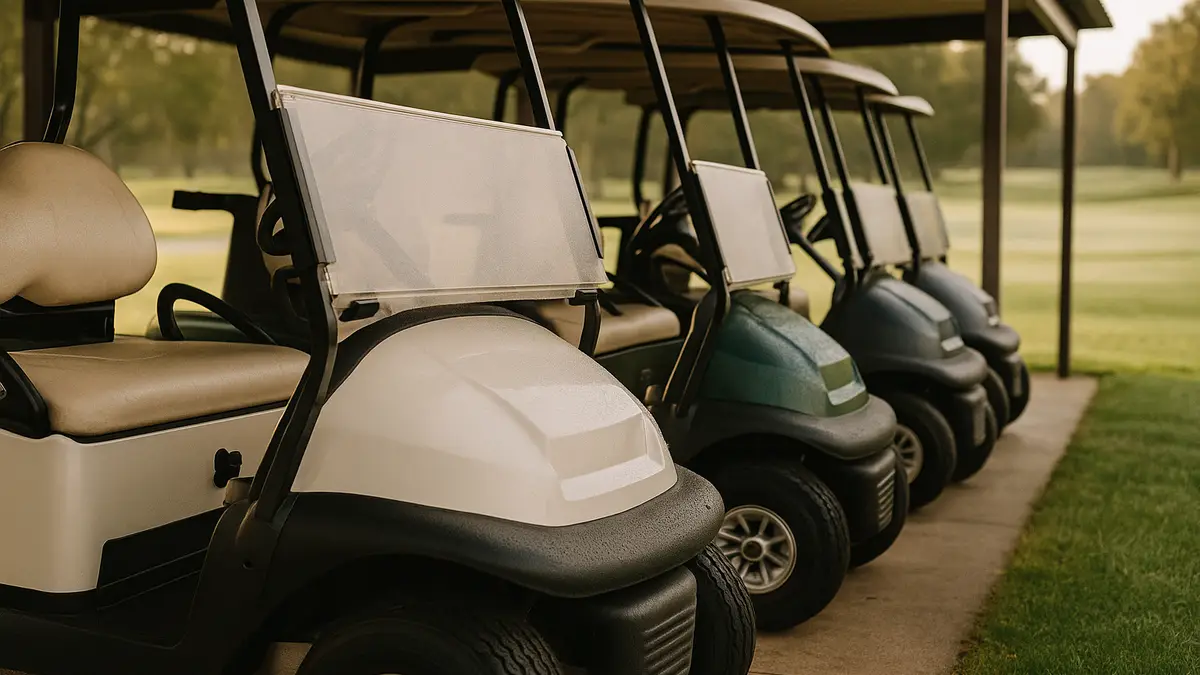
Buying a golf cart used to mean picking a color and a brand your neighbor already owned. Now the decision includes battery chemistry, street-legal equipment, and a price range that spans $1,500 to $16,000 depending on what you choose. Here’s how to narrow it down without guessing.
What exactly is a golf cart?
A golf cart is a low-speed vehicle designed to carry two to eight people at 12 to 15 mph on a course or private property, built on a lighter frame and smaller motor than a UTV or ATV. Street-legal versions, called LSVs, are federally capped at 20-25 mph and require added safety equipment before they can touch public roads.
Electric or gas: which should you buy?
Electric carts dominate new sales because they’re quieter, need less maintenance, and cost nothing to “fuel” beyond electricity. A new electric cart with a lead-acid pack runs $9,000 to $12,500, and one with lithium runs $11,500 to $16,000. Gas carts cost less new, typically $8,000 to $11,000, and they refuel in minutes instead of charging for hours, which matters if you’re covering long distances on rural property without an outlet nearby.
The trade-off is upkeep. Gas engines need oil changes and periodic tune-ups; electric carts need battery care but skip the engine maintenance entirely. For a full side-by-side comparison of running costs and lifespan, see our electric vs gas golf cart breakdown.
How much does a golf cart actually cost?
| Type | Price range |
|---|---|
| New gas | $8,000 - $11,000 |
| New electric, lead-acid | $9,000 - $12,500 |
| New electric, lithium | $11,500 - $16,000 |
| Used, 5-10 years old | $3,000 - $6,500 |
| Used, 10+ years old | $1,500 - $3,500 |
| Custom or luxury LSV | $15,000 - $35,000+ |
Lithium carts cost more upfront but the battery pack lasts roughly twice as long as lead-acid, which changes the real cost over a decade of ownership. Our full cost breakdown covers financing, accessories, and what drives the price within each band.
Which golf cart brand should you buy?
EZGO, Club Car, and Yamaha are the three legacy brands with the widest dealer and parts networks, all built primarily on 48-volt systems since the mid-2010s. Evolution and Icon have grown fast as direct-to-consumer electric brands with simpler ordering and often lower prices for comparable features. Denago fills a rugged, off-road-styled niche at a competitive price point.
There isn’t a single “best” brand; the right one depends on whether you value dealer support, price, or styling. Our golf cart brand comparison ranks all six against each other on price, parts availability, and what each is actually good at.
New or used golf cart?
A used cart 5 to 10 years old at $3,000 to $6,500 gets you most of the utility of a new cart at half the price, as long as the battery pack is sound. Carts over 10 years old drop to $1,500 to $3,500 but often need a battery replacement soon, which can cost $1,000 to $3,200 depending on chemistry.
New carts come with a warranty and current safety equipment, which matters if you plan to register the cart for street use. Our used golf cart buying guide walks through exactly what to inspect before you hand over cash.
Do you need a street-legal golf cart?
Only if you plan to drive on public roads. A standard golf cart tops out at 12-15 mph and isn’t legal outside private property or a course. A street-legal LSV is capped at 20-25 mph under federal rule 49 CFR 571.500 and needs headlights, taillights, turn signals, brake lights, mirrors, seat belts, a windshield, a VIN, and a horn before most states will register it, and most restrict LSVs to roads posted 35 mph or under.
If you’re buying specifically to drive between a beach community and the grocery store, check our street-legal golf cart guide before you shop, since not every model comes LSV-ready from the factory.
How many seats do you actually need?
The standard 2-seat base configuration covers solo and couple use with the tightest turning radius and lowest price at any trim level. A 4-seater adds a rear or forward-facing flip seat without stretching the frame, which is enough for most families. A 6-seater moves to a genuinely stretched limo-style chassis, and an 8-seater scales up to a shuttle-class frame built more for commercial and community use than personal driveways.
Buy for the trips you take most weeks, not the one holiday gathering a year that needs extra seats. Our seating capacity guide covers pricing and handling differences across all four sizes in detail.
What accessories should you plan to budget for?
Most buyers underspend on accessories the first time around and end up buying them separately at a markup. A smart charger runs $150-$400 if one isn’t included with the cart, a weatherproof cover runs $50-$150, and a lift kit for added ground clearance runs $250-$800 in parts or $400-$1,000 installed. None of these are mandatory, but pricing them into your budget upfront avoids the surprise of a “finished” purchase that still needs a charger.
How long does a golf cart actually last?
The frame and mechanical drivetrain on a well-maintained cart routinely outlasts multiple battery packs, often running 15-20 years or more before major structural issues appear. The battery is the real wear item: 4-6 years for lead-acid, 8-12 years for lithium. Budgeting for at least one battery replacement over a typical ownership period is realistic regardless of brand.
Matching the cart to how you’ll actually use it
A golf-course-only cart doesn’t need LSV equipment or a big battery pack. A neighborhood errand-runner does. A property cart hauling tools across rough ground benefits from the added ground clearance and torque that off-road-oriented brands like Denago build in.
Start with where you’ll drive it and how many people ride along, then work backward through brand, battery chemistry, and new-versus-used. That order keeps you from overpaying for features you won’t use, and it’s the same order the rest of our brand and cost guides are organized around.
Frequently asked questions
Quick answers to what readers ask us most
What is the most reliable golf cart brand?
EZGO, Club Car, and Yamaha have the longest production histories and the deepest parts networks, which matters more for long-term reliability than any single spec sheet. See our brand comparison for how they stack up against newer entrants like Evolution and Denago.
Is it cheaper to buy a golf cart electric or gas?
Gas carts usually cost less upfront, $8,000 to $11,000 new versus $9,000 to $16,000 for electric. Electric wins on running cost since there's no fuel or oil changes, but you need somewhere to charge it.
How much should I budget for a golf cart?
Budget $1,500 to $6,500 for a good used cart, or $8,000 and up for new. Add $150 to $400 for a charger if buying used without one, and factor battery replacement within a few years if the pack isn't lithium.
Do I need a special license to drive a golf cart?
Not on private property or a golf course. On public roads, only street-legal LSV-classified carts qualify, and most states require a valid driver's license plus insurance. Rules vary by state, so confirm with your DMV before driving on any public road.